Cryptocompare Is a Guide to Crypto Market Data and Exchange Tools
Cryptocompare Is best understood as a cryptocurrency market data and comparison resource for people who want to research prices, trading volumes, exchanges, indexes, and digital asset trends before making decisions. It can help users compare markets, review exchange activity, understand reference pricing, and organize crypto research. This guide explains what Cryptocompare is, how tools like it are commonly used, and what risks to check before relying on any crypto data source.
Cryptocompare matters because cryptocurrency markets move across many venues at once. Bitcoin, Ethereum, stablecoins, tokens, derivatives, and fiat pairs may trade at different prices depending on the exchange, liquidity, fees, and local market conditions. A user searching for Cryptocompare is usually trying to understand whether the platform can make that fragmented information easier to read, compare, and verify.
What is Cryptocompare?
Cryptocompare is associated with crypto market data, digital asset comparisons, exchange information, and pricing tools. The name is often used by traders, analysts, researchers, and market watchers who need a practical way to compare coins, exchanges, volumes, and market movements. It is not the same thing as a wallet, a bank account, or a guaranteed trading system. Cryptocompare is better viewed as a data and research layer around the crypto market.
Cryptocompare can be useful because crypto prices do not come from one single official source. A Bitcoin price can be quoted from one exchange, an aggregated index, a volume-weighted calculation, or a reference rate designed for institutions. The difference matters. Cryptocompare-style data helps users ask where a price came from, how active the market is, and whether the number reflects broad trading activity or a narrow snapshot.
Cryptocompare has also been discussed in connection with exchange benchmarks, reference pricing, stablecoin market activity, and institutional data products. Those topics point to the larger purpose of the category: making crypto markets more measurable. For a new user, the practical value is not simply seeing a price. The value is learning how that price fits into liquidity, market share, exchange quality, and broader trading behavior.
This page is an independent informational guide about Cryptocompare and related market-data workflows. It does not represent Cryptocompare, cryptocompare.com, any exchange, or any data provider. Crypto markets are volatile, and users should verify details with official sources before relying on data for trading, tax, accounting, compliance, or investment decisions.
How does Cryptocompare work as a market data resource?
Cryptocompare generally fits into a workflow where raw crypto market activity is collected, normalized, organized, and displayed in a form that humans and systems can use. In practice, that may include spot prices, historical candles, trading volumes, pair-level data, order-book information, exchange listings, and aggregated market metrics. The goal is to turn many separate market signals into something easier to compare.
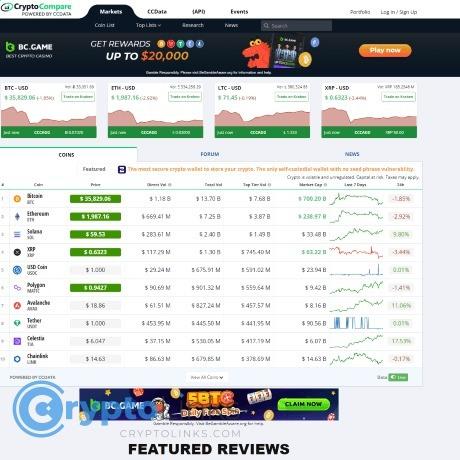
Cryptocompare-style data often depends on exchange feeds. An exchange reports activity for pairs such as BTC/USD, ETH/USDT, or SOL/BTC. A market data platform can then group those pairs by asset, quote currency, venue, and time interval. The resulting view may show current price, daily change, volume, market capitalization estimates, or liquidity patterns. Even when the interface looks simple, the underlying market structure is complex.
Cryptocompare may also be relevant when users look for benchmark or reference pricing. A reference price is different from a random ticker quote because it is usually calculated with a defined methodology. The methodology can account for multiple venues, outlier filtering, volume weighting, time windows, and data quality controls. Anyone using Cryptocompare or a similar service should understand that methodology before treating the number as authoritative.
The practical issue is trust. Crypto data can be affected by thin liquidity, wash trading concerns, delayed feeds, exchange outages, token redenominations, forks, stablecoin depegs, and regional differences. Cryptocompare can help bring structure to the data, but users still need to ask whether the feed is current, whether the exchange coverage is broad enough, and whether the data source explains how it handles unusual market events.
What can users do with Cryptocompare?
Cryptocompare is most useful when it becomes part of a repeatable research process rather than a one-time price check. A casual user may look up a coin price or compare exchanges. A more advanced user may review market share, track liquidity, monitor stablecoin pairs, or study historical price behavior. A business user may care about APIs, indexes, audit trails, licensing, or data consistency across systems.
Cryptocompare can support several common workflows:
- Comparing cryptocurrency prices across exchanges and trading pairs.
- Reviewing exchange volume, liquidity, and market share trends.
- Studying historical price data for Bitcoin, Ethereum, stablecoins, and altcoins.
- Checking whether a reference price appears to come from a transparent methodology.
- Supporting research for portfolio tracking, reporting, analytics, or market commentary.
Cryptocompare may also help people understand why two crypto sites show slightly different numbers. One site may rely on a narrow group of venues, while another may use aggregated data. One may display last-traded price, while another may display a calculated index. Cryptocompare encourages the right question: not just what the price is, but how the price was formed.
For teams building dashboards, research notes, or internal monitoring tools, Cryptocompare-style data can provide a foundation for comparing market behavior over time. That does not remove the need for internal controls. Any firm using crypto data for financial reporting, trading infrastructure, or client-facing material should check licensing rights, data definitions, uptime expectations, and whether the source is suitable for the intended use.
How should a beginner use Cryptocompare step by step?
Cryptocompare can feel overwhelming if a user starts with every chart, exchange, and token at once. A better approach is to begin with one clear question. For example, a user might ask whether Bitcoin liquidity is concentrated on a few exchanges, whether a stablecoin pair is trading normally, or whether a token price changed because of broad market movement or venue-specific activity.
Cryptocompare works best when the user follows a simple research sequence. First, identify the asset and trading pair. Second, compare several venues rather than relying on one exchange. Third, check volume and spread clues because a price with little trading behind it may be less meaningful. Fourth, review historical context. Fifth, confirm the finding with official exchange pages, project announcements, or other reputable data sources.
A practical workflow might begin with a major asset such as Bitcoin or Ethereum. Cryptocompare can be used to inspect the main quoted pairs, compare recent movement, and look at whether volume supports the displayed trend. The user can then move from the general market view into more specific questions about exchange behavior, stablecoin liquidity, or whether a sudden price move appears isolated.
Cryptocompare should not be treated as a substitute for judgment. A beginner should avoid using any single chart as a buy or sell signal. Crypto data can be noisy, and markets can move rapidly during news events, exchange incidents, regulatory announcements, token unlocks, hacks, or liquidity shocks. The purpose of Cryptocompare research is to improve context, not to guarantee an outcome.
Why do exchange rankings and benchmarks matter?
Cryptocompare is often discussed alongside exchange benchmarks because the quality of a price feed depends partly on the quality of the venues behind it. A crypto exchange with strong liquidity, transparent operations, and reliable infrastructure may provide more useful data than a venue with thin order books or suspicious activity. Exchange rankings try to make those differences easier to evaluate.
Cryptocompare-style exchange analysis can look at factors such as trading volume, jurisdiction, security practices, market surveillance, data reliability, liquidity, and operational history. No ranking can perfectly measure exchange quality, but a structured benchmark can help users avoid treating all volume as equal. That distinction is important because inflated or low-quality volume can distort market analysis.
Cryptocompare can also be relevant for institutional users who need pricing products that are more robust than a public ticker. An institution may need hourly rates, benchmark prices, index inputs, or independently calculated reference values. In those settings, methodology and documentation matter as much as the displayed number. Users should review how a benchmark selects venues, handles outliers, and updates during unusual market conditions.
For a retail user, the lesson is simpler. Cryptocompare can help show that exchange choice matters. A token with large volume on trusted venues is different from a token that trades mostly on obscure markets. A stablecoin pair with consistent liquidity is different from one that shows sudden volume spikes after market stress. The more a user understands venue quality, the better they can interpret crypto data.
What are the benefits of using Cryptocompare?
Cryptocompare offers the main benefit of organization. Crypto markets are scattered across exchanges, blockchains, regions, pairs, and data formats. A market data platform can bring many of those signals into one place, making it easier to compare assets and observe trends. That can save time for users who would otherwise need to visit many exchange pages and reconcile conflicting numbers manually.
Cryptocompare can also improve the quality of research conversations. Instead of saying that a coin is up or down, a user can ask whether the move is supported by volume, whether it appears across multiple venues, and whether related assets are moving in the same direction. That deeper context is useful for traders, writers, analysts, founders, compliance teams, and anyone trying to explain market behavior clearly.
Cryptocompare may be especially useful when researching stablecoins, exchange market share, and benchmark pricing. Stablecoin activity can reveal liquidity preferences, stress events, or changes in market confidence. Exchange market share can show where trading activity is concentrating. Reference prices can help users understand how institutional-grade crypto data differs from casual price widgets.
The main advantage is not that Cryptocompare eliminates uncertainty. It does not. The advantage is that it gives users a more structured way to investigate uncertainty. Good crypto research rarely depends on a single number. It depends on comparing the number against volume, venue quality, historical movement, market structure, and the possibility of missing or delayed information.
What risks should users check before relying on Cryptocompare?
Cryptocompare users should approach all crypto data with caution. Digital asset markets can be highly volatile, and the numbers shown on any data platform may be delayed, incomplete, corrected, or based on a methodology that does not match the user's purpose. A price feed used for casual research may not be appropriate for trading automation, tax reporting, portfolio valuation, or regulated financial activity.
Cryptocompare data can also be affected by exchange-level problems. An exchange may halt withdrawals, suffer an outage, list a token with limited liquidity, or show abnormal trading during a market shock. A stablecoin may trade away from its intended value. A token may migrate contracts, split, rebrand, or lose reliable market depth. These events can make historical comparisons harder to interpret.
Cryptocompare should be verified against official sources when the stakes are high. Users should confirm exchange fees, API terms, listing status, trading availability, benchmark methodology, and data licensing directly with the relevant provider. A user should also understand whether data is real time, delayed, indicative, or calculated after the fact. Those distinctions can materially change how the information should be used.
This guide does not provide financial advice. Cryptocompare can support research, but it cannot determine whether a cryptocurrency is suitable for a person's goals, risk tolerance, legal obligations, or financial situation. Users should be careful with leverage, illiquid tokens, promotional claims, and automated strategies that depend on a single data input. Independent verification is part of responsible crypto research.
How does Cryptocompare compare with other crypto data tools?
Cryptocompare sits in a broader category that includes coin-ranking websites, exchange dashboards, charting platforms, blockchain explorers, institutional data vendors, and analytics tools. Each type answers a different question. A blockchain explorer shows on-chain transactions. A charting platform emphasizes technical analysis. An exchange shows its own order book. A market data platform like Cryptocompare focuses on comparing assets and venues across the wider market.
Cryptocompare may be most relevant when the question involves market aggregation, pricing methodology, exchange quality, or cross-venue comparison. A user who only needs to confirm one transaction may prefer a blockchain explorer. A user who only wants to place an order must use an exchange. A user who wants to compare market behavior across venues may find Cryptocompare more aligned with the task.
| Research need | Helpful tool type | What to verify |
|---|---|---|
| Current market price | Cryptocompare-style market data | Venue coverage and update timing |
| Exchange liquidity | Exchange comparison or benchmark data | Volume quality and pair depth |
| On-chain transfer status | Blockchain explorer | Network, address, and confirmations |
| Trading execution | Crypto exchange | Fees, spreads, custody, and availability |
Cryptocompare is not automatically better than every alternative. The right tool depends on the question. Serious users often compare multiple sources because crypto data can diverge. If several reputable sources agree on price, volume, and market structure, confidence may improve. If they disagree, the disagreement itself becomes a useful signal that more research is needed.
What should users remember before getting started?
Cryptocompare is most valuable when used as a disciplined research tool. Start with a clear question, examine multiple data points, and avoid treating a single market number as a complete answer. Crypto markets reward careful context because price, liquidity, volume, exchange quality, and timing can all change the interpretation of the same event.
Cryptocompare can help users compare crypto assets, study exchange behavior, and understand market data workflows, but the final responsibility remains with the user. Verify important details with official sources, read methodology notes when available, and be cautious about financial decisions based on volatile assets. Used carefully, Cryptocompare can make digital asset research more organized, transparent, and practical.
Questions and Answers
What is Cryptocompare used for?
Cryptocompare is used for researching cryptocurrency market data, including prices, trading pairs, exchange activity, historical movement, volume, and reference pricing concepts. Users may use it to compare markets, understand liquidity, or support broader crypto research. It should be treated as a data resource, not as a guaranteed trading signal or a substitute for independent verification.
Is Cryptocompare the same as a crypto exchange?
No. Cryptocompare is best understood as a market data and comparison resource, while a crypto exchange is where users place orders, hold balances, or trade assets. A data platform can help users review prices, volumes, and exchange differences, but actual trading, custody, fees, and account security are handled by exchanges or wallet providers.
Can Cryptocompare data be used for investment decisions?
Cryptocompare data can support research, but it should not be the only basis for an investment decision. Crypto markets are volatile, and data may vary by venue, methodology, liquidity, and timing. Users should verify important details with official sources, understand the risks of digital assets, and avoid treating any single price feed as financial advice.
Why do crypto prices differ between Cryptocompare and exchanges?
Prices can differ because platforms may use different exchanges, calculation methods, update intervals, quote currencies, and filtering rules. One exchange may show a last-traded price, while a data platform may display an aggregated or weighted value. Liquidity, spread, and market stress can also create short-term differences between displayed crypto prices.
What should beginners check first on Cryptocompare?
Beginners should start with a major asset, a clear trading pair, and a simple comparison across several exchanges. It helps to review price, volume, recent movement, and whether the market looks liquid. Beginners should also check whether the data is current and confirm important details with official exchange or project sources before acting on the information.
Is Cryptocompare safe to rely on for crypto market research?
Cryptocompare can be useful for crypto market research, but no data source should be relied on without context. Users should consider update timing, exchange coverage, methodology, licensing terms, and whether the data fits their intended use. For trading, tax, accounting, or compliance purposes, users should verify information through official and professionally appropriate sources.